
The OWL Model
A Relational, Story-Based Brand System For International Schools
Through working inside complex school communities, we began to see where traditional linear models started to strain.
1. Why We Built It
School ID had launched, but something was not fully aligned. We were speaking fluently to marketing professionals, yet not fully connecting with school leaders. We were describing services, but not clearly articulating the deeper institutional tension we address.
That tension was familiar.
Many schools list programs and facilities yet struggle to clearly express what distinguishes them. Communication becomes louder rather than clearer.
When we reframed our own work around a central insight, everything shifted: Branding in schools is not primarily about selling. It is about building belonging.
Once that became explicit, our positioning sharpened. Language simplified. Visual decisions became easier. Content aligned more naturally with the motivations of school leaders and communications teams.
That internal realignment exposed a gap in many traditional brand frameworks.
Our earlier work, including strategic branding at Western Academy of Beijing, began with established strategic tools such as the Brand Pyramid or Brand House. These frameworks provide clarity and structure, and they were instrumental in building alignment at the time.
Working deeply inside a school environment sharpened our understanding of what schools uniquely require from brand strategy. Schools are not transactional systems. Internal culture directly shapes external perception. Leadership, faculty, families, and students co-create experience daily.
Brand Strategy must intentionally shape how that relational dynamic evolves.
That experience clarified the need for a model built specifically for the relational complexity of international schools.
2. The OWL Model
OWL stands for Ongoing Watching and Learning. It reframes brand from a static framework into an active stewardship system.
It is not a linear framework. It is a relational system designed for school communities.
The model consists of three interconnected spaces:
- Identity Defined
Where a school clarifies who it is through structured research and internal alignment. - Core Community
The motivation groups who participate in the school’s lived story. - The OWL Space
The dynamic space where identity and perception meet.
Motivations bring the community into the OWL Space. The school responds with a clear promise, supported by visible proof. Personality and emotional anchor guide how that promise is expressed. Watching and listening continue.
When perception drifts from intention, communication adjusts.
Identity remains stable.
Expression evolves.
Brand is managed.
Story is experienced.
Managing Brand in the OWL Space
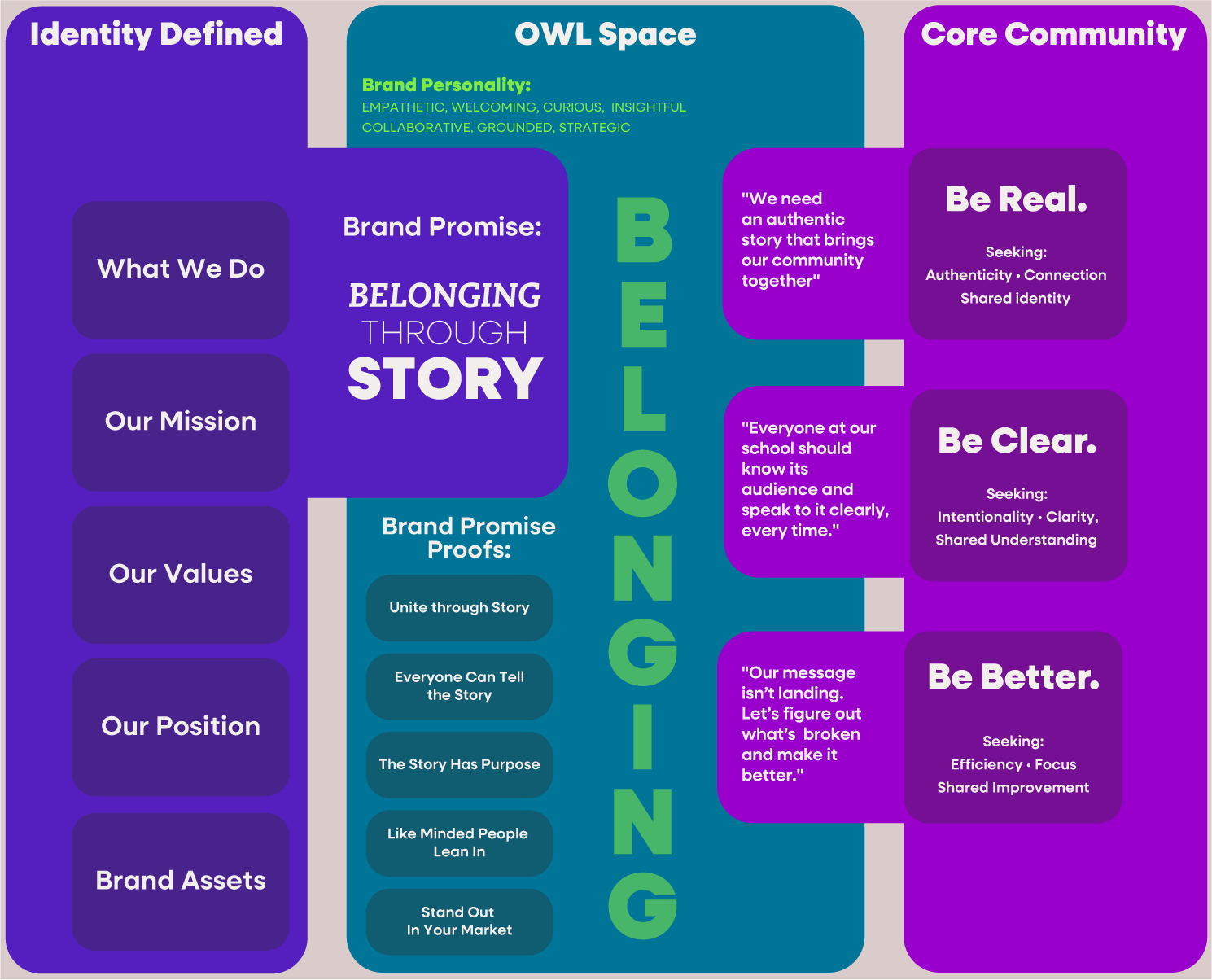
Identity provides the foundation. Core Community brings motivation. The OWL Space is where brand is actively managed, where promise, proof, personality, and belonging shape how perception evolves over time.
Managing Brand in the OWL Space
Identity provides the foundation. Core Community brings motivation. The OWL Space is where brand is actively managed, where promise, proof, personality, and belonging shape how perception evolves over time.
3. How it Shaped Our Own Brand
We applied the model to ourselves first.
In conversations with school leaders, marketing directors, and community members, a clear pattern emerged. Schools may hesitate around the word “brand,” yet they care deeply about their story. They want their values understood, their strengths recognized, and their communities aligned.
What they resist is branding reduced to logos and slogans.
The OWL Model reframed our own work. We stopped leading with services and began leading with alignment. We moved from listing deliverables to clarifying institutional tension. We stopped separating brand from culture and treated perception as something shaped daily through behavior and communication.
Two insights anchored that shift.
Belonging is the common thread. Schools approach strategy for different tactical reasons, but the deeper desire is almost always stronger community.
Story is the bridge. Strategy becomes practical when it guides storytelling that reflects lived values rather than surface messaging.
Once that became clear, decisions simplified. Visual choices narrowed. Vocabulary stabilized. Content planning aligned directly with motivation rather than output volume.
The model did not create a new look.
It created internal coherence.
From Strategy to Messaging: How We Tell Our Story
The OWL Model does not end in theory. It shapes how schools communicate, what they emphasize, and how they steward perception over time.
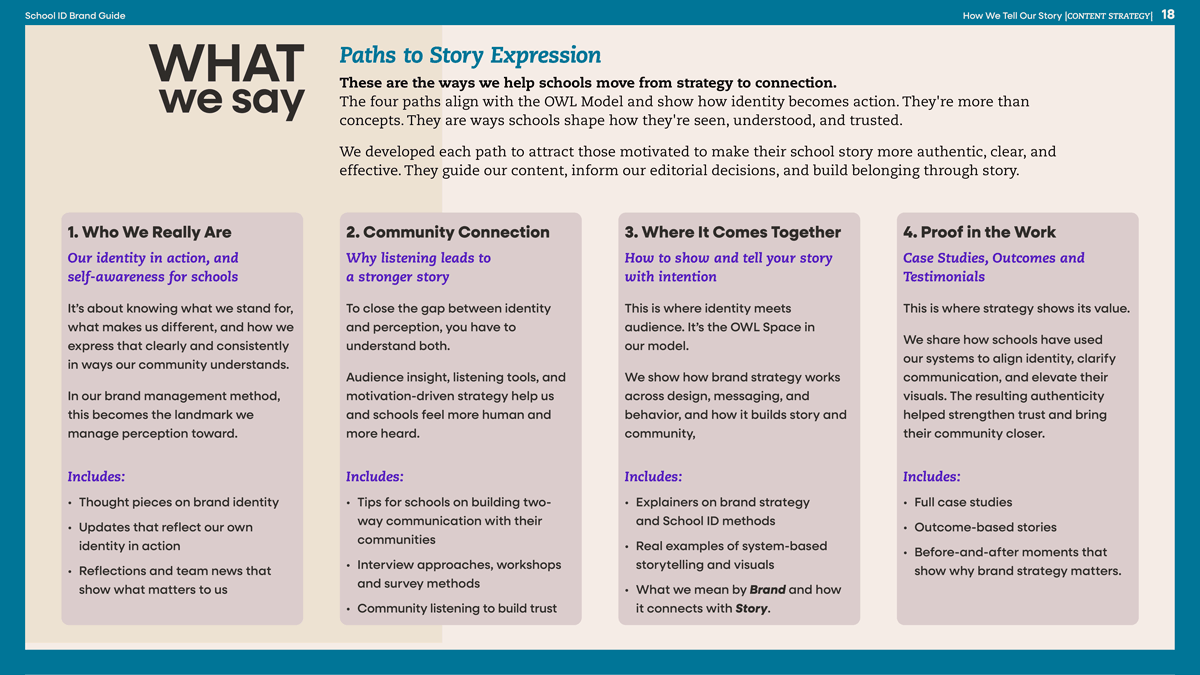
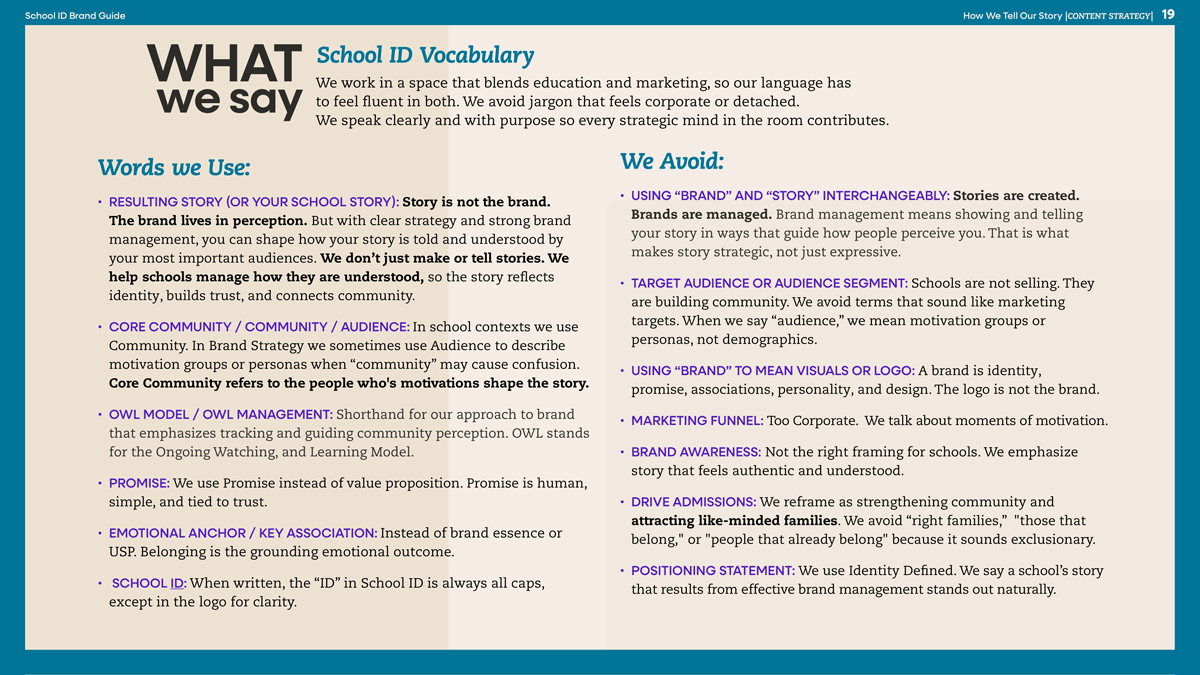
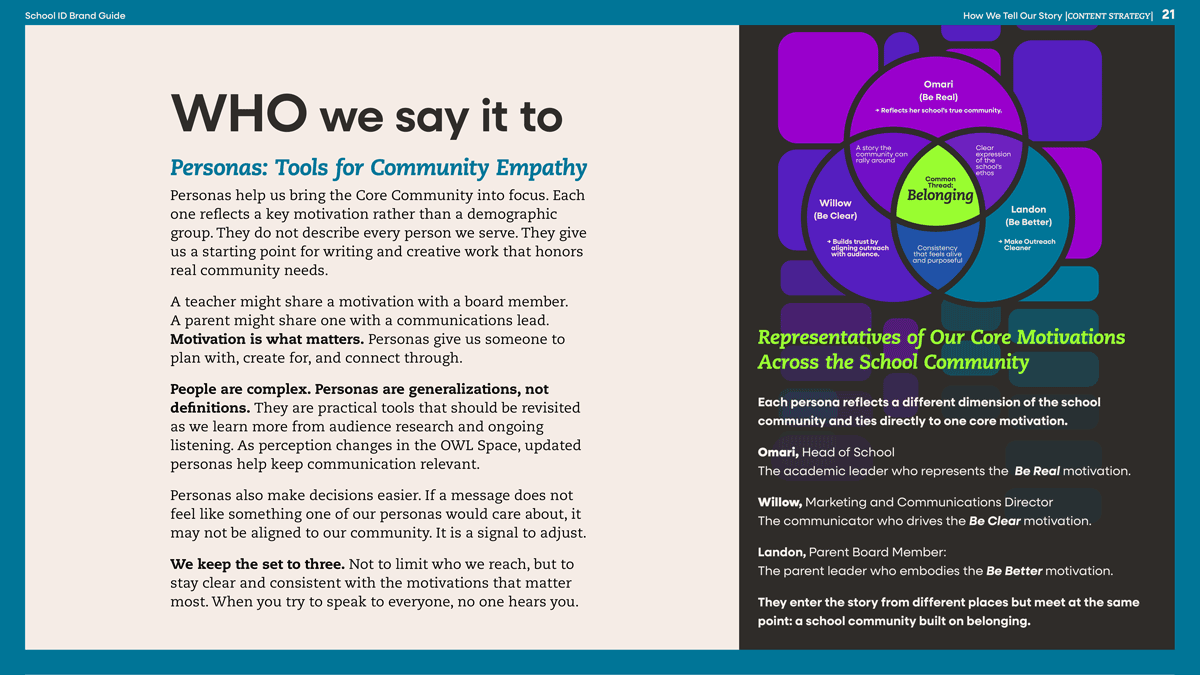
In our brand books, identity and community are first clarified within the OWL Model. That strategic foundation then informs two applied systems: How We Tell Our Story, which guides messaging and editorial structure, and How We Show Our Story, which shapes the visual system.
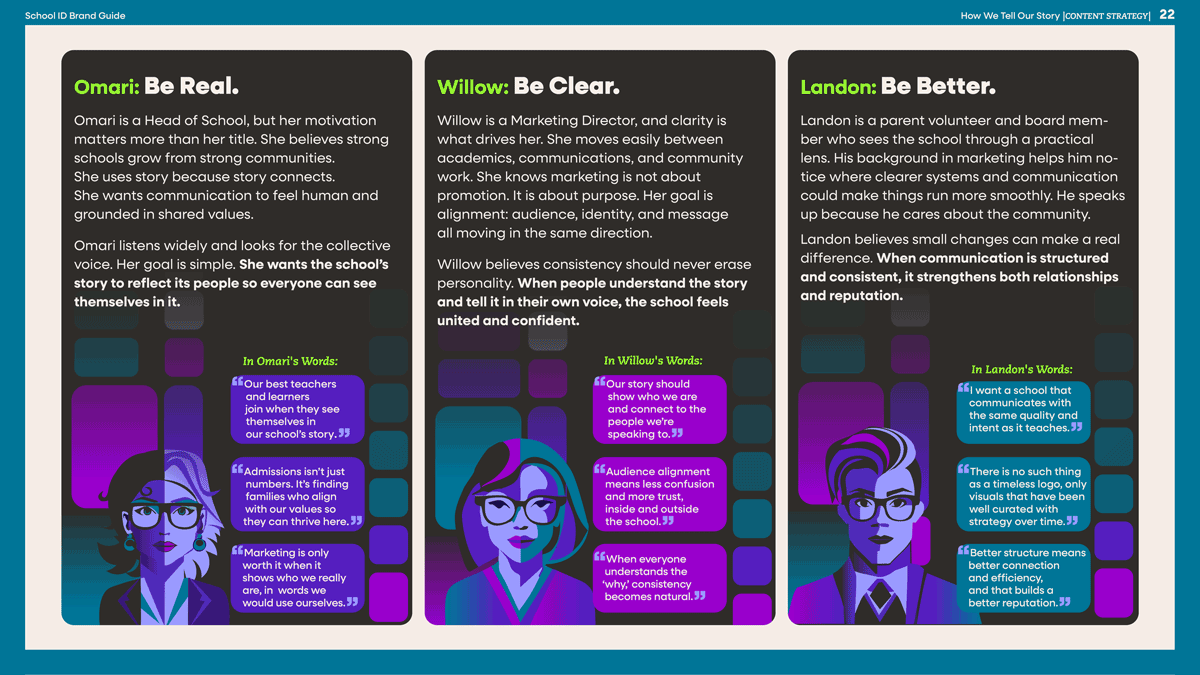
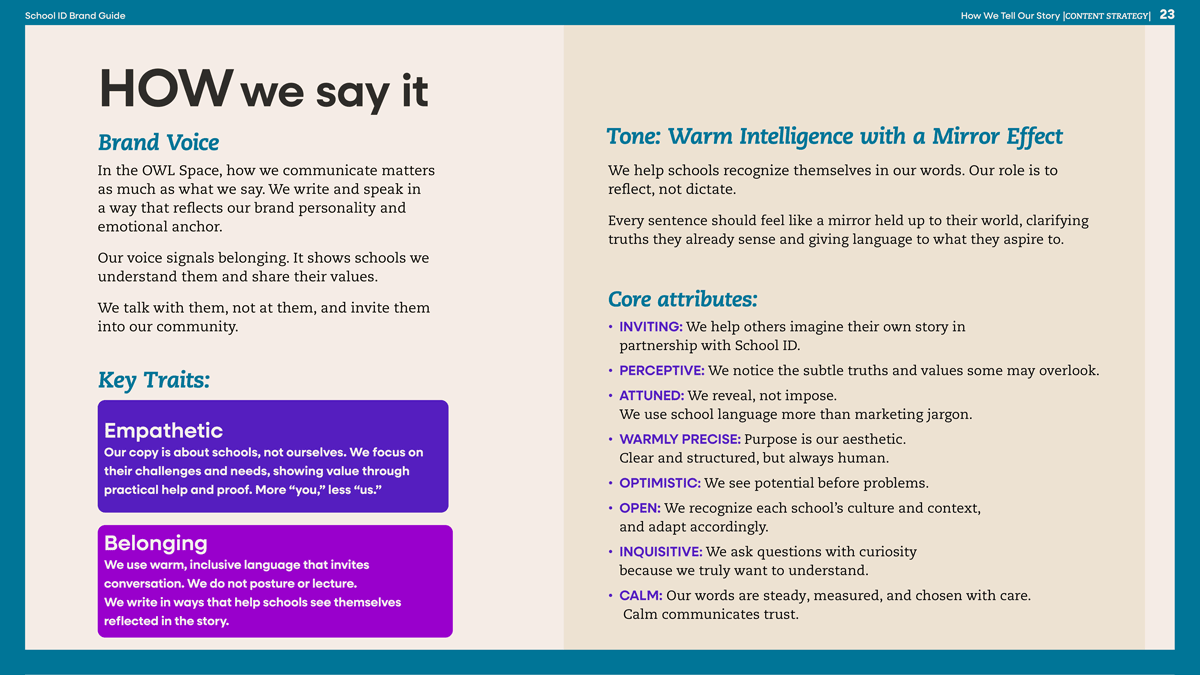
The excerpts below are drawn from the messaging guide. They demonstrate how editorial decisions flow directly from strategic intent rather than sitting apart from it.
4. Reflection: How It Helps Schools
International schools operate within layered complexity. They navigate cultural nuance, competitive markets, diverse families, and evolving leadership. Communication in this environment cannot rely on instinct alone.
The OWL Model offers structure without corporate rigidity. It supports alignment beyond the marketing department and grounds communication in motivation rather than assumption. It integrates directly with messaging and visual systems so that strategy does not sit apart from execution.
More importantly, it reframes brand as stewardship rather than promotion.
Brand becomes an ongoing practice of listening, clarifying, and refining. Identity remains steady. Expression adapts. Perception is managed intentionally rather than left to drift.
The goal is not louder messaging.
It is coherent expression of institutional purpose.
When that coherence is present, belonging follows.

