Thoughts about "what art does" by Brian Eno and Bette A.
When I was growing up, music was a big deal. My dad was a music teacher, choir director, and multi-instrumentalist. He was also a collector. He had countless stringed instruments and a giant, eccentric recorded music library. Days could start with James Brown and end with The Clash. He introduced me to rap with the first Run DMC release, yet I also knew Philip Glass’s The Photographer by heart.
But commonalities were there if you paid attention. What did those weird Bowie 70’s records have in common with The Talking Heads’ Fear of Music (one of my all-time favorites), or that odd quiet one that came out once in a while: Music for Airports? Brian Eno was a big deal.
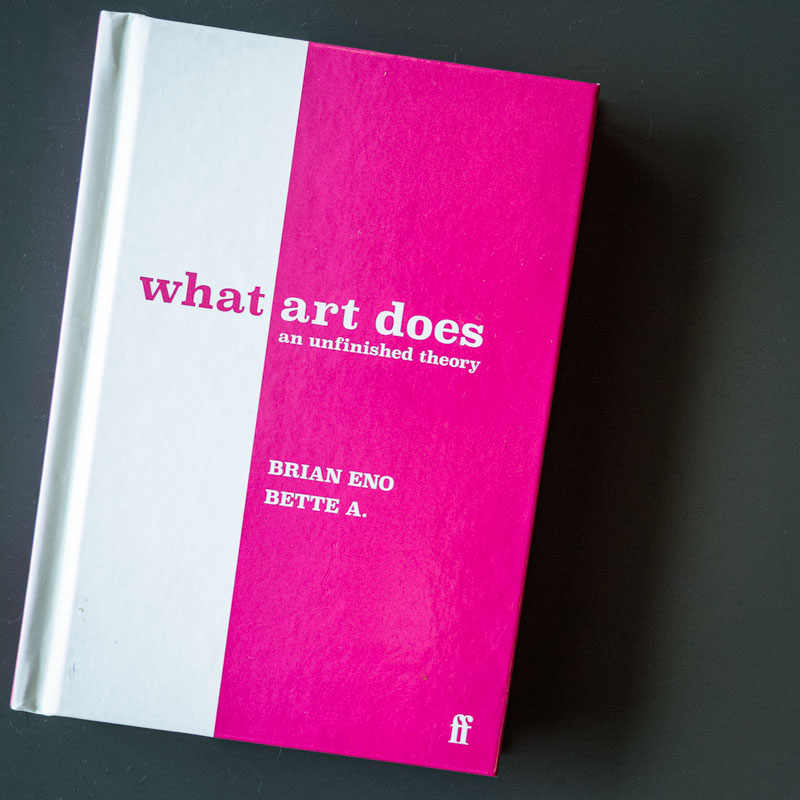
Last fall, I saw he was being interviewed on one of my favorite podcasts. Nostalgia made me listen. But what stuck with me almost as strongly as Fear of Music did decades ago was the conversation itself. A swirling, deep talk between Eno and Ezra Klein about art as something that does, not something that is. That stuck. Within days I was in a bookstore buying what art does by Brian Eno and Dutch artist and educator Bette A.
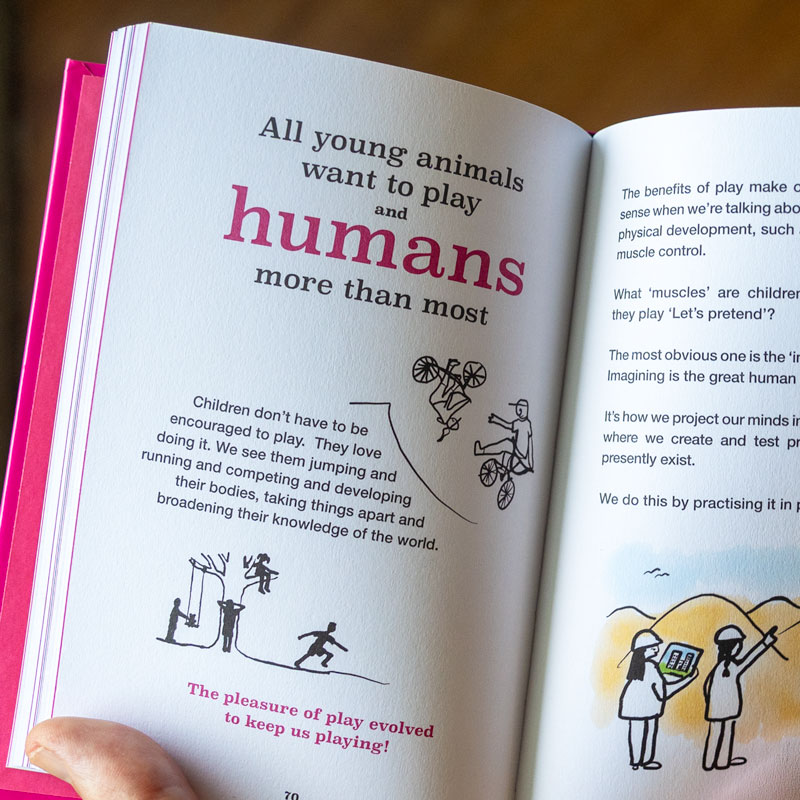
It is a very short, small, illustrated book. It takes very little time to read. And yet I would bet I have spent more time reading it than anything else this year. Because I keep coming back to it. It fits neatly in my carryon. I have likely read it on every flight I have taken since.
It is subtitled “an unfinished theory,” and I think that may be part of why I keep coming back to it. What art does is less a systematic argument and more a series of organized musings, provocations the authors keep circling back to. Each one opens up something new the longer you sit with it. The ideas don’t resolve. They generate.
How It Applies to Schools
When I read this book, I keep thinking about how its ideas show up in my work with schools. And in my own history with art.
My dad was not just a music teacher. He was a great proponent of keeping the arts in public schools. He was one of the great ones. He won the awards. He was the living version of that trope you see in movies, the one where the tough football players get pulled into choir and find a new passion in something they once thought was at best silly, at worst a threat to their reputation. Some of those guys still sing.
Eno and Adriaanse get to this. They lay out art as a universal human activity and argue that defining what it does is more vital than what it is. As they put it: “If we can’t answer that question, then we shouldn’t be surprised when governments marginalise the arts and humanities in education, or when the ‘brighter’ students are directed away from the arts and into science and tech.” (p.5)
In the book, art is presented as a universal way of communicating and processing feelings. A way of creating safe worlds that can fundamentally change us. They contrast art with science. Science, they say, is the attempt to strip a situation of feeling so that outcomes become predictable and repeatable. Useful, often necessary, but not how most of real life actually works. Feelings come quicker than thoughts.
Most of us think we usually make the most logical decisions each time. but the reality is this logic is often colored with feeling. This is the zone of brand strategy work. Emotions dominate most decisions, especially the most important ones.
Ever notice when scientists speak about experiments, they often talk less of the results than the process taken to remove ambiguity, or feeling? Maybe this process is actually the art within science.
This is not a knock on science. As someone with a background in biology and ecology, I have my own deep respect for that kind of careful, ambiguity-removing work. The point is just that the discipline of removing feeling is itself a craft, and that craft has more in common with art than many think.
“Feelings are powerful precisely because they aren’t articulated.” (p. 29)
The Book:
Eno, B., & A., B. (2025). What art does: An unfinished theory. Faber & Faber.
The Podcast Interviews:
Klein, E. (Host). (2025, October 7). Brian Eno on AI, Art and What Makes Us Human [podcast episode]. In The Ezra Klein Show. The New York Times. https://www.youtube.com/watch?v=AfYY9v0Q0X4
Rushkoff, D. (Host). (2025). “What If” Is the Enemy of Fascism (w/Brian Eno) [podcast episode]. In Team Human. https://www.youtube.com/watch?v=vV0CM8smqU8
Why This Matters To Me
When I was in college, early on I was in studio arts classes. I drifted toward the more applied, businessy side of art: graphic design and marketing. It wasn’t that I disliked the studio classes or the subject. Although I did find many of my classmates and professors repulsively pretentious. It was fear. Fear that I would never get a real job. That I needed to know the “more important” skills, which at that time meant PCs and the internet.
I learned the software, the technical stuff. But ironically, what really informs my design work today? The art classes were much more important. Color theory, contrast, balance, perspective (linear and atmospheric), art history, and even the muscle memory of the motor skills those strenuous life drawing classes built all seem more valuable to each day than how to use software or code.
Now, with a daughter who has similar interests looking at school with AI on the horizon, I will not talk her out of art school. Art is the future. Right now, content is cheap and mountainous. The only kind we notice is the stuff that makes us feel. That’s what art does.
What About Lifetime Learning?
Many schools claim to encourage lifelong learning, even as they promote STEM as consistently more important than the arts. But what if art is by definition lifelong learning?
One of the central thoughts in the book lays out play as how children learn. And art as how adults play.
Read that twice. Because if it is true, then art is not a luxury. Art is the learning that continues across an entire human life.
Sometimes we learn more from the worlds created in fiction than from the smartest, most resourced non-fiction. Because fiction lets us explore perception itself. It runs simulations. It lets us change our minds, or change how we feel about what we already understand, all within a safe place. The authors describe art as an escapable simulation, a safe place to test our views and let them shift.
That is not soft. Or, less than logic. That is foundational. And it is exactly the capacity that becomes most valuable in a world where output is no longer scarce.
Why This Matters to School ID
Brian Eno was a pioneer of generative music. The idea that the system making the sound could itself be the art. The simplest version of a generative music maker is a windchime. Eno used tape loops and technology to far more sophisticated ends in his work. He was building systems-generated content nearly fifty years before the release of ChatGPT.
Brand is our generative art.
We build the systems that define and manage the feelings around a school. Some days we wish that work were more science than art. It isn’t. But the real art may not be what most people think. It is not so much the visuals or the logos. It is the systems we define before any of those things get made. Those systems guide where the visuals go, how the content sounds, what the school feels like when it shows up in the world.
Which means the capacity that art classrooms develop, the ability to make intentional systems that produce feeling and meaning, is the same capacity that brand strategy requires. The same capacity good school leadership requires. The same capacity humans will need most in the era that is arriving.
Art is not what some people do while others do the real work. Art is the real work, not the waste of your university studies. It can be a story that causes you to rethink your ideas, a school shaping how it shows up in its community, and of course a musician building a generative system that produces ambient music.
This is why I keep coming back to the book. And it is why, when schools ask what brand strategy actually is, I sometimes find myself thinking about my dad, and about the football players who learned to sing, and about a small illustrated book that fits in a carryon. No, there may not be just one simple answer. The reasons keep generating.

How is your school's story generated?
Brand is many things. The goal isn’t to reduce it to one. It is to get clear enough about yours that all of those things work together. It’s a frame and tool ensuring your story is understood in all the right ways.
We can help and a Discovery Session is a good place to begin.