International school marketers don't just translate between departments. They translate between entire worlds. And when its done well, almost nobody notices they're doing it.
You’re in a leadership meeting. The Head of School wants to talk about “what marketing is doing about enrolment.” You know, and you’ve known for a while, that enrolment isn’t really a marketing problem. It’s a brand clarity problem, possibly a community trust problem, and somewhere downstream, yes, a marketing problem. But that’s a fifteen-minute conversation that this meeting doesn’t have room for. So you nod, and you take the brief, and you go back to your desk and figure out how to run a campaign on top of a foundation nobody has agreed to build.
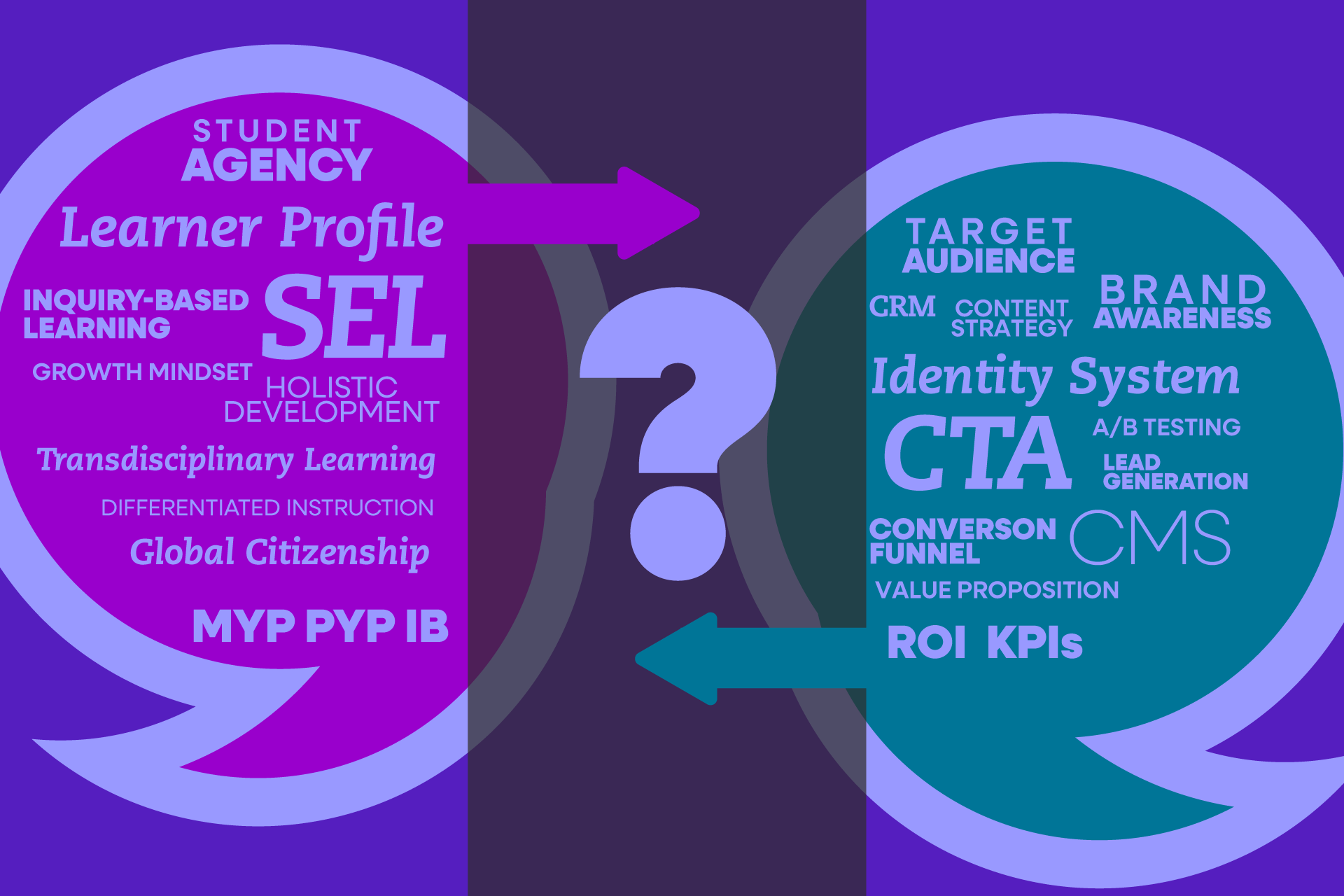
Later that week, you’re briefing a content writer on a piece for prospective families. The curriculum team has handed you their key messages: student agency, transdisciplinary learning, the learner profile, holistic development. Beautiful ideas. Genuinely meaningful to the educators who live them every day. And almost entirely opaque to a parent who is trying to work out whether your school will give their child the skills, confidence, and opportunities they’re hoping for.
Internationally, if those parents are coming from an educational culture where school means structured achievement, clear performance benchmarks, and teacher authority, the gap widens further. “Student agency” doesn’t just need translation. It needs reframing from the ground up. The concept is still valid and valuable in that worldview, but getting there requires a different kind of care and context than simply rewording a phrase.
You are fluent in education language, marketing language, and at least one parent community’s unspoken expectations. You translate between all three, usually in the same day. Nobody has given you a job title for that.
The Jargon Runs in Every Direction
But here’s the part that’s harder to admit. Marketers, and this is worth sitting with, don’t always help. Because the same professional who will spend an afternoon carefully turning “inquiry-based learning” into language a prospective parent can feel will walk into a leadership meeting and say something like this:
Head of School:
"Why aren't more families choosing us?"
Marketing Leader:
"We need to optimise the top of the funnel."
Head of School:
"Parents don't understand what makes us different."
Marketing Leader:
"There's a brand awareness gap in our key segments."
Head of School:
"Our community feels disconnected lately."
Marketing Leader:
"Engagement metrics are down across channels."
Head of School:
"Our community email outreach isn't connecting."
Marketing Leader:
"Open rates and CTR suggest we need to rethink the comms cadence."
Head of School:
"I don't think our school's story is landing."
Marketing Leader:
"We need stronger messaging aligned to our positioning framework."
None of those responses are wrong. Every one of them is, technically, accurate. But accuracy isn’t the same as communication. The Head of School hasn’t been given an answer. They’ve been handed a second language to learn, in the middle of a conversation they were already trying to have.
The translation reflex that works so well outward, toward families and community, somehow switches off in the room where it’s needed most. And so both sides leave the meeting feeling unheard. The educator thinks the marketer doesn’t get the school. The marketer thinks the leadership doesn’t understand what marketing actually is. Both are right. But without a shared language, neither can hear it.
What This Actually Asks of You
International school marketing roles are, in practice, translation roles. That’s not a diminishment. It’s one of the most demanding kinds of strategic work there is. It requires holding multiple frames at once: the school’s identity, the leadership’s priorities, the audience’s cultural context, and the discipline of communication itself.
Most of the time, that work is invisible. The campaign lands, the newsletter goes out, the open day runs smoothly, and nobody pauses to notice the layers of interpretation that made it coherent. When it doesn’t work, when a message misfires or a campaign fails to connect, the translation breakdown is rarely named as the cause.
Getting better at this isn’t just about sharper writing or smarter targeting. It starts earlier, with a shared language inside the school, before anything is said to the outside world. When leadership and marketing are working from the same foundation, when both sides understand what they’re actually trying to solve, the translation work gets cleaner. And the message that eventually reaches families, in whatever language or cultural context they’re coming from, has something real underneath it.
That shared foundation is the work that sometimes doesn’t happen. It’s also, almost always, where the real difference gets made.
Why do we bring this up?
School ID works at the intersection of international school insight and professional brand strategy, which means we spend a lot of time in exactly these translation gaps. If any of this feels familiar, it probably means we have something worth talking about.
If this is a headache you recognise, a School ID Discovery Session might be a good place to start.